
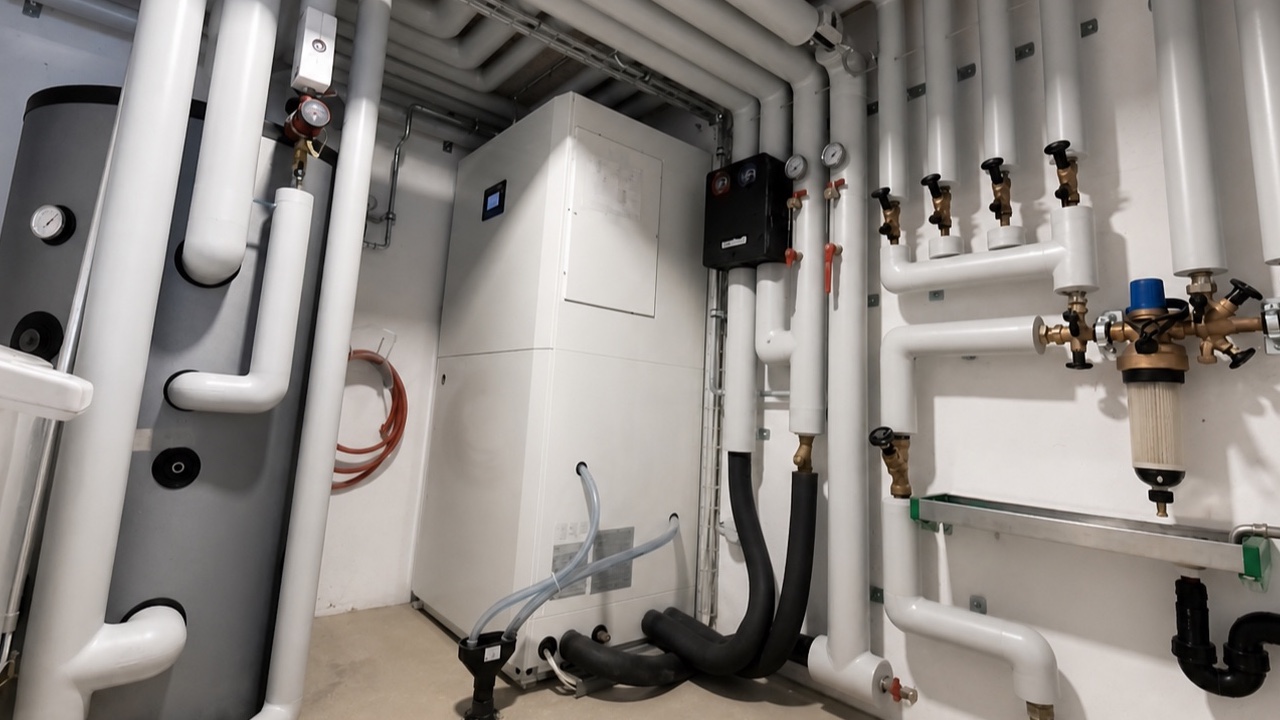
Air is a complete path
The air strategy includes intake location, external conditions, protected openings, filtration where required, fans, distribution, return or relief paths, pressure relationship, heat and humidity control, power, controls and maintenance. Selecting a filter before the scenario and airflow are defined reverses the design process.
The Swiss shelter description is useful because it presents intake, protection valves, prefilter, ventilation unit, gas filter and overpressure components as a connected system. A different project may require a different arrangement, but the same systems-thinking principle applies.
Water and wastewater must balance
Potable water demand depends on occupants, duration, climate, food preparation, hygiene and any special use. Storage volume alone is not the answer: turnover, water quality, tank access, leakage, pumping, pressure, cleaning and replacement must be addressed.
Every litre used becomes wastewater or another managed waste stream. Toilets, hand washing, drainage, holding capacity, odour control, backflow risk and disposal after the event need one coordinated basis.
Power includes heat and fuel consequences
Electrical loads are prioritised as essential, deferrable or unavailable. The concept then considers the normal supply, transfer arrangement, backup source, distribution, protection, monitoring and safe shutdown. Batteries, generators and fuel each bring ventilation, heat, fire, maintenance and replacement implications.
Cooling demand cannot be ignored. People, lighting, electrical equipment and air treatment release heat inside a protected boundary. A backup source that runs the fan but cannot maintain a safe temperature does not support the complete operating target.
Communication needs an operating plan
External communication, internal alerts and access to essential information depend on equipment, power, signal paths, service providers and procedures. Redundancy should avoid a common single failure rather than simply duplicating the same dependency.
The operating plan defines who monitors systems, how faults are recognised, which action follows an alarm and when occupants move to a safe-degradation or evacuation response.
Verify the chain
Calculations and product data are followed by installation inspection, functional tests, integrated tests, operating instructions and periodic retesting. Test conditions and acceptance criteria should be written before procurement so the client knows what evidence will be delivered.
- Demand and duration calculation
- Failure-mode and dependency review
- Maintainability and consumables schedule
- Installation inspection and specialist tests
- Integrated operating scenario and handover training
- Retest, replacement and change-control intervals
Conclusion
Coordinate services as complete operating chains. A protected shell, filter, tank or generator can be essential, but none of them alone defines the capability of the occupied space.
Evidence
Sources and further reading
- Shelters for the populationSwiss Federal Office for Civil Protection
- Plan Ahead for DisastersReady.gov